
Great Zimbabwe was a Bantu ruined city in the south-eastern hills of Zimbabwe near Lake Mutirikwe and the town of Masvingo. It was the capital of the Southern most famous Kingdom of Zimbabwe during the country’s Late Iron Age. Construction on the city began in the 11th century and flourished until its abandonment in the late 15th century.
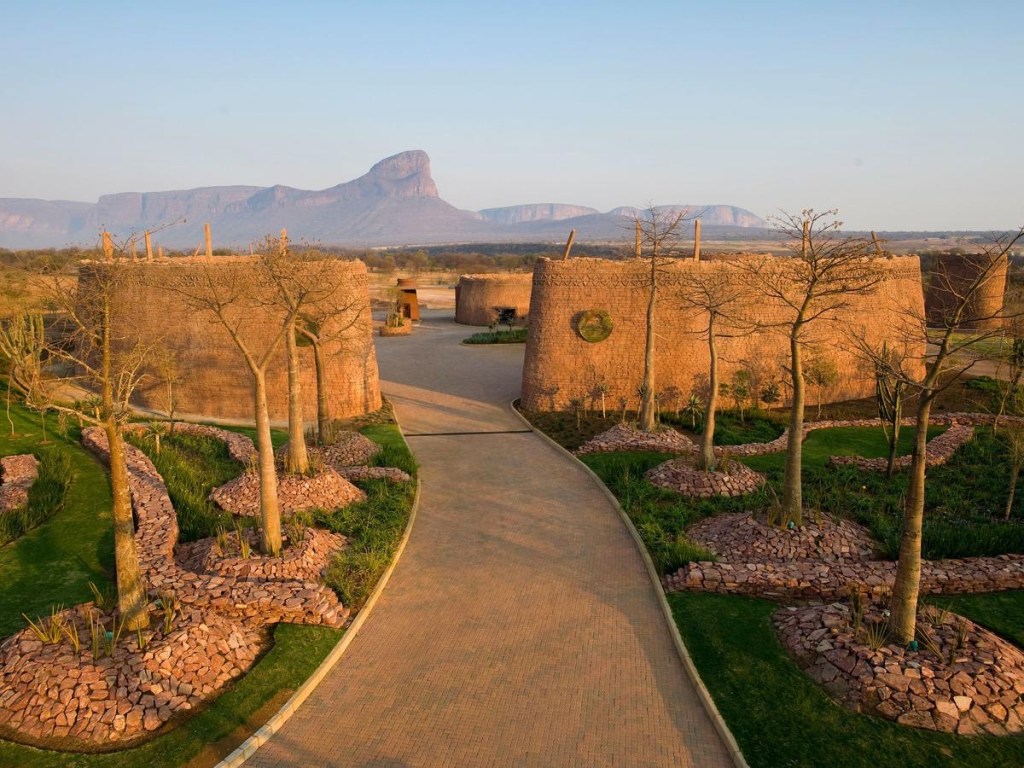
Great Zimbabwe, extensive stone ruins of an African Bantu Iron Age city. It lies in southeastern Zimbabwe, about 19 miles (30 km) southeast of Masvingo. The central area of ruins extends about 750 hectares, making Great Zimbabwe the largest of more than 150 major stone ruins scattered across the countries of Zimbabwe and Mozambique. The city’s buildings were made of impressive granite walls, embellished with turrets, towers, decorations and elegantly sculpted stairways. The most notable of the buildings, an enclosure 250 metres in circumference and 9.75 metres high, was crafted with 900,000 pieces of professionally sliced granite blocks, laid on each other without any binders. Its perimeter columns were decorated with soapstone sculptures of a silhouetted bird with human lips and five-fingered feet.


A Portuguese sea captain, Viçente Pegado, was one of the first foreigners to encounter the site, in 1531. He wrote: “Among the goldmines of the inland plains between the Limpopo and Zambezi rivers is a fortress built of stones of marvellous size, and there appears to be no mortar joining them … This edifice is almost surrounded by hills, upon which are others resembling it in the fashioning of stone and the absence of mortar, and one of them is a tower more than 12 fathoms high.” It is estimated that the central ruins and surrounding valley supported a population of 18,000. With an economy based on cattle husbandry, crop cultivation, and the trade of gold on the coast of the Indian Ocean, Great Zimbabwe was the heart of a thriving trading empire from the 11th to the 15th centuries. The word Zimbabwe, the country’s namesake, is a Shona (Bantu) word meaning “stone houses.” Only 200 to 300 members of the elite classes are thought to have actually stayed inside its massive stone buildings, watched over at night by guards standing on the walls, while the majority lived some distance away.

The site is generally divided into three main areas: the Hill Complex, the Great Enclosure, and the Valley Ruins. The first two are characterised by mortarless stone construction, but they also include ruined daga (earthen and mud-brick) structures that may once have rivaled the stone buildings in grandeur. The Valley Ruins, located between the Hill Complex and the Great Enclosure, include a large number of mounds that are remnants of daga buildings. Today, the ruins of Great Zimbabwe are a shell of the abandoned city that Captain Pegado came across – due in no small part to the frenzied plundering of the site at the turn of the 20th century by European treasure-hunters, in search of artefacts that were eventually sent to museums throughout Europe, America and South Africa.

It was said that Great Zimbabwe was an African replica of the King Solomon’s palace during the visit of the Queen of Sheba in Jerusalem, the European invaders envisaged Great Zimbabwe as the remains of King Solomon mines. A racist German explorer Karl Mauch, who visited in 1871 and refused to believe that indigenous Africans could have built such an extensive network of monuments. His ignorance and biases led him to think that only people who looked like him could have built that great work in the middle of Bantu people, ignoring the fact that he was the first that people who looked like him(Caucasians) had no provable history of existence in Africa prior to the beginning of slavery. In 1905, however, the British archaeologist David Randall-MacIver concluded the ruins were medieval, and built by one or more of the local African Bantu peoples. His findings were confirmed by another British archaeologist, Gertrude Caton-Thompson, in 1929, and this remains the consensus today. In the language of the builders’ descendents, the Shona people who live in the region today, Zimbabwe means “big stone houses” or “venerated houses”.
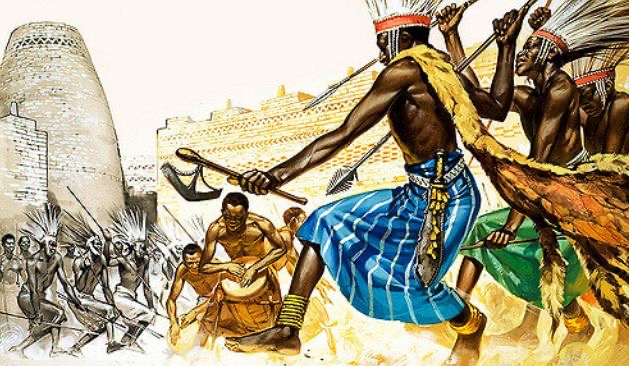
In the early 16th century, rumours of a mysterious fortress with gargantuan walls, abandoned in the African jungle, spread around Europe. Surrounded by goldmines and sitting on a 900-metre-high hill, the city was thought to represent the summit of a unique African civilisation which had traded with distant Asian countries, including China and Persia. In the 16th century the Mwene Matapa’s realm was invaded by the Portuguese, who moved in from the east coast beginning in the 1530s. When the reigning Mwene Matapa attempted to expel them in 1629, they deposed him and forced his successor to grant them extensive trading and mining privileges. By the late 17th century, the power of the Mwene Matapa was overshadowed by the Rozwi kingdom of southwestern Rhodesia. More than 4,000 gold and 500 copper mines were stolen from around the site, and it was suggested that for three centuries, 40% of the world’s total mined gold came from the area, compounding to an estimated 600 tonnes of gold. Thousands of necklaces made of gold lamé have been discovered among the ruins.

When Great Zimbabwe began its economic and military decline in the late 1400s, some of the city’s elites migrated 200 miles north to the Zambezi River and established the short-lived Shona state of Monomotapa (Mutapa). The state emerged around 1500 under Nyatsimba Mutota, the first mwene (king), a warrior prince of the Kingdom of the Great Zimbabwe who gained control of the surrounding gold producing region and much of the Zambezi River Valley. Mutota established a new capital at Zvongombe, near the Zambezi River. At the height of its power under Mutota’s son Mwene Matope, Monomutapa included the entire Zambezi River Valley (modern day Angola, Zambia, Tanzania, and Zimbabwe) from Zumbo in what is now North Central Mozambique to the Indian Ocean.

Mwene Matapa, a Shona word for “Owner of the lands” is a title borne by a line of kings ruling a southeast African territory between the Zambezi and Limpopo rivers, in what is now Zimbabwe and Mozambique, from the 14th to the 17th century. Their domain was often called the empire of the Mwene Mutapa, or simply Mutapa, and is associated with the historical site known as Zimbabwe, located in the southeastern part of modern Zimbabwe. Mutape also means molten gold or metal ancillary to the mining and smelting industry and the production of all metal products in the Kingdom, such as guns, spears, hoes, axes and various ornaments which were exported to countries overseas such as India, Portugal, China, Persia and gave rise to Great Zimbabwe as the earliest civilisation in the world only second to Egypt. Mutapa also became known as Master of the Forge.
H. Moyana and M. Sibanda in their book, The African Heritage, give the example of the Kongo Kingdom where the founder was called ‘Ntinu Mwene’ which in Shona means, ‘You are the Owner’, which in English would mean, ‘You are the King, Lord, Owner, Custodian or Master’. According to Moyana and Sibanda, Ntinu Mwene is also referred to as Inventor of the Forge and the Art of the Iron Smith, the same titular meaning as Mutapa associated with the production of tools from molten gold or iron. The Kongo King, again, according to Moyana and Sibanda, was also called the Manikongo which means Lord or Ruler of the Kongo, Maker of the Arms of War and Tools of Agriculture. ‘Mani’ is derived from ‘Mwene’ which means ‘Owner’, both in Shona and Kikongo. One can therefore refer to Mwene Mutapa as ‘Manimutapa’ which can be easily corrupted to ‘Monomotapa’.

Mutota’s son and successor, Nyanhewe Matope, extended this new kingdom into an empire encompassing most of the lands between Tavara and the Indian Ocean. This empire had achieved uniting a number of different peoples in Southern Africa by building strong, well-trained armies and encouraging states to join voluntarily, offering membership in the Great council of the Empire to any who joined without resistance. Matope’s armies overran the kingdom of the Manyika as well as the coastal kingdoms of Kiteve and Madanda. By the time the Portuguese arrived on the coast of Mozambique, the Mutapa Kingdom was the premier Shona state in the region. He raised a strong army which conquered the Dande area that is Tonga and Tavara. The empire had reached its full extent by the year 1480 a mere 50 years following its creation.
And the identity of the Bantu remains a mystery, but a lie no more as the modern findings rediscovering their true identity of the children of the God, the so called bloodline of the biblical Israelites, their languages, knowledge and culture from such early age reflects nothing but a civilised people. Many accounts of Bantu expansion from as far as Middle East has been recorded, many more from within the land of Khemet; currently known as Egypt. A significant, courageous and hardworking people who changed the face of Africa for better, the same people who helped build Egypt both as slaves and Citizens, the same who built 12 kingdoms in the interior of Sub Saharan Africa, including the Kongo Kingdom, the Lunda Empire, Luba Kingdom, Kuba Empire, the Baganda Kingdom, etc, the same who built America with their bare wounded hands as slaves, and the same who will emerge and rule the world from nothing. Bantu speaking people will rise again, Praise be to the Most High.
Discover more from BANTU=BIBLICAL ISRAELITES
Subscribe to get the latest posts sent to your email.
 BANTU=BIBLICAL ISRAELITES
Does your website have a contact page? I’m having a tough time
locating it but, I’d like to shoot you an email.
I’ve got some ideas for your blog you might be interested in hearing.
Either way, great blog and I look forward to seeing it improve over time.
These are genuinely impressive ideas in concerning blogging.
You have touched some fastidious points here. Any way keep up wrinting.
It is the best time to make some plans for the future and it’s time to be happy.
I’ve read this post and if I could I desire to suggest you some interesting
things or tips. Perhaps you can write next articles referring to this article.
I want to read even more things about it! http://alexa.com
My web page: John
LikeLike
It’s perfect time to make some plans for the future and it’s time to be happy.
I’ve read this post and if I could I wish to suggest you some
interesting things or advice. Maybe you can write next
articles referring to this article. I desire to read more
things about it! Hello just wanted to give you
a quick heads up. The text in your content seem to be
running off the screen in Safari. I’m not sure if this is a formatting
issue or something to do with web browser
compatibility but I figured I’d post to let you know.
The layout look great though! Hope you get the problem solved soon. Thanks bookmarked!!, I like your website!
http://House.com/
Feel free to surf to my blog post; Amy
LikeLike
Everyone loves what you guys are up too. Such clever work and reporting!
Keep up the good works guys I’ve included
you guys to our blogroll. Hello would you mind stating which blog platform
you’re using? I’m planning to start my own blog in the near future but I’m having
a tough time choosing between BlogEngine/Wordpress/B2evolution and Drupal.
The reason I ask is because your layout seems different then most blogs and I’m looking
for something unique. P.S My apologies for getting off-topic but I had to ask!
Way cool! Some extremely valid points! I appreciate you writing this write-up and
also the rest of the website is very good. http://cspan.co.uk
My blog post Kiersten
LikeLike
What a data of un-ambiguity and preserveness of valuable know-how concerning unexpected emotions.
LikeLike
Hi, I do think this is an excellent website. I stumbledupon it ;
) I may come back yet again since I saved as a favorite it.
Money and freedom is the greatest way to change, may you be rich and continue to
help other people. Hi, I log on to your new stuff regularly.
Your humoristic style is awesome, keep up the good work!
I seriously love your site.. Great colors & theme.
Did you develop this amazing site yourself? Please reply back as I’m trying to create my own personal site and
would like to find out where you got this from or what the theme is called.
Thanks! http://ford.com
My web blog: Will
LikeLike
Enjoyed all bit of your blog article. Will door on
LikeLike