From Kemetic, Cushitic and Bantu perspectives
Through colonial narratives rooted in misinformation and whitewashing of history, the term Bantu or Abantu was loosely translated to simply mean ‘people’ or ‘humans’, which was based on the observation of the plural prefix ‘Ba’ which is found throughout Africa below Sahara, and the stem/suffix ‘Ntu’ which appears in various forms as Ntu, Ndu, Tu, Nu, Tho, To, etc. This article aims at bringing tangible evidences to correct mistakes and generational lies told by those who wanted to view us as an inferior people, by those who intended to write us out of the history of every civilisation around the world and write themselves at the centre thereof, in the end you will decide whether or not the word Bantu simply means a linguistic group or a people who share a common genetic ancestor, common cultural and spiritual heritage.

In western anthropology ‘Bantu speaking people’ as they coined it is commonly defined as an African people who migrated from modern South East Nigeria and Cameroon to the vast geographical area of South, Central and East Africa, this notion was created by European ethnographers with little to no knowledge of the people with sole intent to overlook not only the cultural and linguistic similarities between scattered Bantu tribes but also their irrefutable biblical customs before even the arrival of Europeans, also their oral migration history from not only West Africa (Ur), but also the ancient land of Egypt in North Africa and land of Kush in Eastern Africa. They coined it Bantu “speaking people” to refute any form of unity which at the time was a threat to colonial rule, however in the African reality this is just a tip of the iceberg. Bantu is NOT a general term meaning “people”, it is far deeper than that, when we say Bantu or Abantu, we are referring to a large group of people, tribes, clans, an ethnicity if you like stretching from Central to Southern Africa, a people who not only share a common linguistic ancestry but also culture, customs and DNA. Due to migrations and captivities which left Bantu people scattered not only physically but also linguistically, what’s even more fascinating is the amount of similarities which have survived hundreds or thousands of years of separation, for instance variations of the term Bantu exists throughout Central, Eastern and Southern Africa, among Basotho and Batswana for instance it is “Batho”, in Chewa “Anthu”, in KiSwahili “Watu”, in Bangala “Batu”, in Baluba “Bato”, in Shona “Vanhu”, in Gikuyu/Embu “Andū”, in Lala “Banu”, Zulu Duala and Xhosa “bantu”, Nyanja “anthu”, Baganda, Bemba and Kinyarwanda (Hutu) “abantu”, Siphuthi “batfhu”, Lunda and Meru “Antu”, Kwaya “Abhanu”, Setswana “Batho”, Bembe “batu”, Sepedi “batho”, Yeyi “awatu”, Bahunde “bandu”, Kamba “Andu” in Venda “Vhathu”, etc. The only reason European scholars needed to claim that Kiswahili came from Arabic is because they did not want to admit that Kiswahili; a Bantu language is as much Shemitic as Arabic is and recognising its Bantu origin would include all the 600 Bantu languages which share just as much similarities with Arabic as Kiswahili. Unlike today’s Hebrew which is primarily a invention from Slavic, German and Latin, the ancient language of the bible is Bantu (Kabiru) expanded into 600 Sub Saharan African Bantu languages which explains why Arabic is similar to Kiswahili and other Bantu languages, no language can breakdown the bible better than Bantu languages(see the African who wrote the bible).

Bantu Culture teaches that we have a divine origin and thus our essence is divine, this is our higher nature and we must always strive to live according to our higher nature which is our true nature, hence we say we are the bena Nzambi, which is Kikongo for sons and daughters of God, our highest performance is when we work together and this is the enemy strive when we are divided. In Bantu languages, the term Bantu is a plural of Muntu, a Muntu is literally a divine being, a person who lives according to their higher nature. The word ‘nto’ or ‘into’ (pronounced ‘een-toh’ ) in Nguni and Kikongo means ‘a thing’, ‘a thing that merely exists’ this is in reference to animate or inanimate objects that are not human. In contradistinction, ‘ntu’ is the divine essence, this is the suffix ‘ntu’ in the term Mu-ntu. The concepts of ‘nto’ and ‘ntu’ inform us of the difference between body and soul or physical and spiritual, it also highlights the similarities thereof. Ubuntu which is a related term means having the character of being a Muntu, values of Ubuntu includes love, good character, righteousness, compassion, my brother/sister’s keeper etc.., but Ubuntu also demonstrates the relationship between Muntu and his maker, hence Aba-Ntu, a Muntu has Ubuntu, and when someone loses Ubuntu the individual cannot be truly classified as Muntu. They loose the ntu essence and become ‘into’; a thing, a being without a soul so to speak. When one forget the laws, they’re no longer in the image of the Creator or representing the Creator, they’re spiritually dead, basically a body without a soul, in Kiswahili when a person is without soul they are referred to as Muzungu (Spirit of destruction), which is the opposite of Mungu (Creator). From ABANTU you have two words, NTU which is a suffix associated with divine essence; from ubu-ntu, aba-ntu. Ntu refers to a people, a nation, an ethnicity or lineage of. Mu-ntu and Ba-ntu are singular and plural forms of the divine (Ntu). ABA- is a prefix and variation of Abba and Baba which means Father, Creator, God. Aba-Ntu then refers to a people whose culture is uBuntu ( The Law written in their hearts), who practice isiNtu ( The culture/norms and traditions of Aba), Aba-ntu means God’s Nation/people, descendants of God (Psalm 82:6).

Despite our differences, Ancient Egyptians, ancient Cushites and the Canaanites (Batwa/Khoisan) had a higher regards of the Bantu, this is so because they were all proud of their Central African origins, they all believed that life began in this very part of the world, that’s why unlike the Europeans, the word Ntu was not new to Ancient Egyptians whom like the Bantu, they were black together with the Kushites, Canaanites. In the language of hieroglyphs (Mdw Ntr) ‘nt’ or ‘nti’ is a reference to ‘things that exist’ or ‘that which is’ ‘what is’, nti is also a relative particle ‘who, which etc..’ , rules, ordinances and regulations are known as ‘nt’ and those who are righteous are called ‘Ntiu’, in African Cultures those who uphold divine laws/rules are the righteous, they live a righteous existence, these are ”Ba-Ntu” in contemporary African Culture. Ntu (or read Nut) in ancient hieroglyphs means ‘those who’ and is written with a determinative symbol of a person or a deity, these determinative symbols are important to note because Ntu being divine, Muntu therefore is a divine person or a righteous person. Another fact of great importance, while everyone is familiar with the word “Alkebulan” which means mother of mankind and garden of Eden, many people are not familiar with TaNtchru; the Kemetic name for Africa. While Kemet (Egypt) means land of the blacks, TaNtchru (Africa) in hieroglyphs means “Land of gods”. And the specific central region of TaNtchru which they considered to be the holiest of holy, the place of origin of mankind and the centre of the universe was called TaKhent. On the modern map, TaKhent which means land of the beginning is the land between the Nile River and Congo Basins (Jubilees 8:12-20). We know that Mesopotamia (Land Between Two Rivers) was also Babylon which was the land of Kush Ethio-Sudan), now we also know that the land Between Two Rivers which is right next to Ethio-Sudan is the true origin of human civilisation. Scientists agree that there are two points of origins, one in Central East Africa and the other in West Asia, but West Asia has been exclusively limited to an ancestor of the Eurasians from the caucus mountains, who mixed with the African humans migrants and produced modern Eurasians and the likes. DNA samples show that the haplogroup E and the mitochondrial Eve lived in Central Eastern Africa and not the so called Middle East.
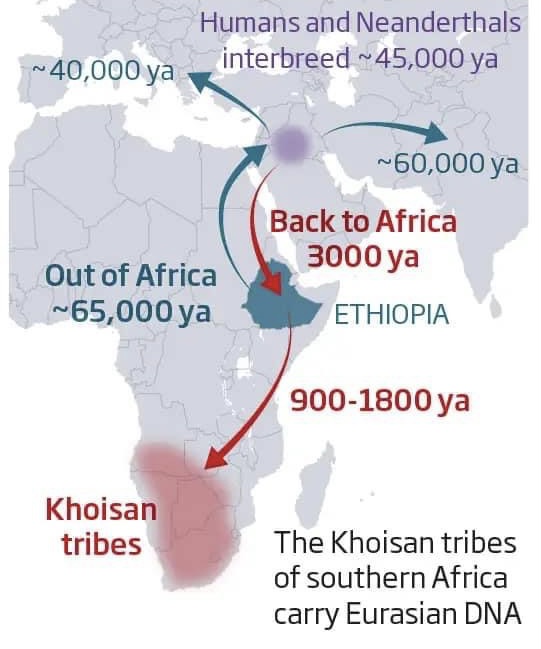
TaKhent (Central Africa) is said to have been predominantly inhabited by the BaTwa. The name BaTwa is in reference to “lands”, this is the case for their relative Khoisans. In the back to Africa migration, archeology and DNA has shown a presence of Batwa people in as far as Egypt and the so called Middle East (MAP), this mimics the biblical accounts of Canaan son of Ham whom according to Jubilees 10:28-34, after the partition of land among the children of Noah, Canaan refused his original portion of land which was supposed to be in Middle East next to his brothers and took over the vast rich land of Shem in the South thereof, the same land the Egyptians called TaKhent. The Canaanites later became allies of the Philistines (Tutsis) who were an Egyptian people and adversaries of the (Bantu), matter of fact the Canaanites (Twa) are said to have been influential in the early building of the Egyptian civilisation, the word Twa for instance in Kemetic means “lands”. As in the common Kemetic phrase “Sema Twa” (Union of the Lands), the people of Kemet considered the BaTwa as their spiritual guides. The BaTwa were divine in Kemetic eyes to the point that the deity Bes is the literal deification of the BaTwa people. One could not be crowned Nsut-Bity (pharaoh) or Qo-Re unless a BaTwa sacred physician performed the Bes dance at their coronation, and furthermore many Bantu kings were seduced to take council from the Batwa people because of their magical abilities whether in Central or Southern Africa.

It is almost impossible to separate so called Sub Saharan Africa from Egypt, the Abantu lived in Egypt for over 300 years where they influenced the Egyptians with their monotheism and male circumcision, also with their farming and agricultural skills. One of the famous pharaohs of all times by the name Ramses III has been proven genetically to be of Bantu stock, many Bantu people lived in Egypt as high authorities including the Biblical Joseph and Moses who was saved from the reeds of the Nile by the daughter of a Pharaoh. In ancient Kemetic hieroglyphs, the prefix “Ba” which is of Bantu origin means “Divine Self”. Ba is also the highest of the 9 aspects of the Egyptian concept of a being (Ka, Ab, Ba, Akh, Sekhem, Sahu, Ren, Khaibet, Khet) because Ba represents the highest achieving union between the physical and the spiritual, in other words the manifestation of the relationship between God and his people Aba-Ntu. The Bantu are the 600 African tribes who’s culture gave birth to the universal book called the Bible, the Old Testament for instance and the Torah (Tulah) of Ubuntu given to Moses represents the everyday customs of the Bantu people, the descendants of Aba-Ntu have been oppressed by various people who wanted to take away this divine knowledge, including the Babylonians, the Assyrians, the Egyptians, and most recently the Caucus of both Arabia and Europe. If you are Abantu in Africa below Sahara, or in both Americas, or elsewhere, know that you are the people of the book, Abantu means the bena nZambi which literally means the sons and daughters of God. Your part is to wake up and awake others, and your responsibility is to live a righteous and fulfilling life and always be your brother/sister’s keeper, go out to the world and shine your light, Muntu also means head in Kikongo, there is a Bantu saying which says if the head is sick the rest of the body is sick and as I always like to say “To whom much is given much is required” Luka 12:48.
References:
- An Egyptian Hieroglyphic Dictionary Vol 1, Wallis Budge (1920)
- African Cosmology of the Bantu Congo, Kimbwandende Kia Fu-Kiau Bunseki (2001)
- Odwiraman Afahye Nhoma, Kwesi Ra Nehem Ptah Akhan (2016)
- The African Origin of Civilisation, myth or reality, Sheik Anta Diop (Translated edition by Mercer Cook 1974)
Discover more from BANTU=BIBLICAL ISRAELITES
Subscribe to get the latest posts sent to your email.
 BANTU=BIBLICAL ISRAELITES